香港寵物小精靈村落 論壇

 找回密碼
 加入
樓主:
打印 上一主題 下一主題

[求助] 化學方程式

[複製鏈接]
21
發表於 26/1/2008 06:20 PM | 只看該作者
原帖由 fish 於 26/1/2008 05:15 PM 發表
被人吵醒....來寫幾句先


用Molecular Orbital (MO) Theory 可解釋
http://en.wikipedia.org/wiki/KO2
link 中的 "structural trend in dioxygen compounds" 那表中的bond order 跟stability有關
bond order  ...


謝謝了....
估唔到咁深....

orbital概念是有小小的
但wiki卻很多不認識英文..及很多專用名詞:L
再看我會暈.........

另想問多問而已
了解多點bond order便算了..
http://en.wikipedia.org/wiki/Bond_order
甚麼是antibonding electrons&bonding electrons...
比些例子我最好
例如N≡N ...
其中既no. of antibonding electrons&bonding electrons係幾多...


-0-"謝謝魚大
回復

使用道具 舉報

22
發表於 27/1/2008 02:58 AM | 只看該作者
原帖由 比超仔 於 26/1/2008 06:20 PM 發表
甚麼是antibonding electrons&bonding electrons...
比些例子我最好
例如N≡N ...
其中既no. of antibonding electrons&bonding electrons係幾多...


MO theory與Wave function有關,我沒有那邊的數學知識(只知是要用differential equation)
不過不緊的....知道orbital是由Wave function計出來就行了
Atomic orbital其實不是一個個圓形就算的,有sperical, dumbbell(ed) shape等,全是由wave function計出來的 (CE那個是簡化了做圓形)
普遍來說,electron都會先fill up 最低energy 的orbital 先,每個orbital可容納2粒electrons,且他們都會 spin in opposite direction 以減低repulsion

Molecular Orbital Theory is related to wave function and details of it require skills of differential equations.
In reality, atomic orbitals are NOT circular rings, they are of 3D geometry and have various shape like spherical and dumbbell(ed) shape; they can be interpreted from the wave function.
In general, electrons will fill up orbitals with lower energy, and an orbital can hold 2 electrons at maximum. The 2 electrons should spin in opposite directions to minimize repulsion.

-------------------------------------------------

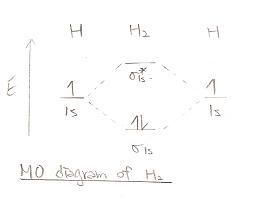
用最簡單的H2為例子:
Bonding orbital(σ) is formed by the addition of two wave functions.
Antibonding orbital(σ*)  is formed by the subtraction of two wave functions.
()中的atomic 或molecular只是用來分清是哪種orbital.....平常沒必要的話可免掉

第一個orbital 是1s (atomic)orbital,H atom中的那一粒electron會occupy 1s (atomic)orbital
我們知H2 是covalent molecule,所以當兩粒H atom react時,electron不會只留在其中一個H那邊,而是shared. 所以有需要去用另一個方法表達在H2中的electrons.
兩個H的orbital 加起來減起來時會分別出了σ1s 及σ1s* (用wave equation計的)
這兩個σ叫Molecular orbital(s), 有*的是antibonding, energy較高,所以放在1s的上面;σ1s比1s的energy 低,所以位置較低(如圖)

The first (atomic) orbital is 1s. So, the only electron in an H atom will occupy the 1s (atomic) orbital.
Since H2 is a covalent compound, when two H atom reacts, electron would be shared among the two atom instead of staying in one of the hydrogen.
For this reason, we need to use the MO theory to describe the electrons in the H2molecule.
When the two 1s orbitals in the two H atoms add up and subtract, σ1s and σ1s* would be determined. ( Determined by wave function)
These two σ are the Molecular orbital(s). The one with * is the antibonding orbital which is of higer energy, so it would be placed above 1s. σ1s is of lower energy than 1s, so it is placed under 1s(as shown in the picture).

-------------------------------------------------

兩則的H 是指要react的兩個H atom,中間的H2可理解為product
由於物質都想處於較低的energy狀態(Lower energy, more stable),所以他們會fill up σ1s先,而箭咀亦因要opposite spin而變為相反
Fill 完σ1s後,,兩個H atom的2粒electron已用完~不能fill σ1s*

Bond Order = (bonding electron - antibonding electron) /2
                      = (沒星的orbital中的electron量 - 有星的orbital中的electron量) /2
                      = (2-0) /2
                      = 1   
------------------------------------------------------------------------------------------------------------------------------------------------------
遊客,本帖隱藏的內容需要積分高於 4800 才可瀏覽,您當前積分為 0


離題很遠了XD......看完不明就無視吧XD

Plus:
對了...CE及AL的在別人叫你畫H2或其他molecules 時不要送上面的東東給他們......兩個syllabus都沒要求學MO theory的....被扣分可別找偶
回復

使用道具 舉報

23
發表於 27/1/2008 11:10 AM | 只看該作者
Fish...
這不是大學程度的東西嗎?我才剛學呢。
中學生應該很難明白吧?
回復

使用道具 舉報

24
發表於 27/1/2008 11:20 AM | 只看該作者
原帖由 dolphin_ice 於 27/1/2008 11:10 AM 發表
Fish...
這不是大學程度的東西嗎?我才剛學呢。
中學生應該很難明白吧?

好像大部分中六一開始就有得學...
回復

使用道具 舉報

25
發表於 27/1/2008 11:34 AM | 只看該作者
原帖由 dolphin_ice 於 27/1/2008 11:10 AM 發表
Fish...
這不是大學程度的東西嗎?我才剛學呢。
中學生應該很難明白吧?

MO Theory是,但hybridization(VB)不是.....基本上懂VB就會明MO
況且人家問....見有騙分的機會嘛:hug:
但已盡量簡化了

好像大部分中六一開始就有得學...

學應知的Lewis Structure, VSEPR及VB Theory而已.....當然包括Quantum吧.....
沒那3個Bonding Theory....後面學的都會有點缺漏...較明顯的是Acid-base, transition element chem及organic chem
三者都要求較多對bonding 的認知....尤是organic chem....一大堆Lewis acid-base rxn, radical chem
回復

使用道具 舉報

26
發表於 27/1/2008 08:51 PM | 只看該作者
原帖由 abc666 於 27/1/2008 11:20 AM 發表

好像大部分中六一開始就有得學...

可是我中四呢.....:hug:

原帖由 fish 於 27/1/2008 02:58 AM 發表

MO theory與Wave function有關,我沒有那邊的數學知識(只知是要用differential equation)
不過不緊的....知道orbital是由Wave function計出來就行了
Atomic orbital其實不是一個個圓形就算的,有sperical, dum ...

好像有點兒明吧....
似總太多不懂的term了 :') :')
再自已努力研究吧...- -"
回復

使用道具 舉報

27
 樓主| 發表於 28/1/2008 05:50 PM | 只看該作者
又來找麻煩/死時間

Miss又畀左2題CE題我地做...

25:鈣與冷水起反應,生成一種無色氣體。
     (a)寫出上述反應的化學方程式。
     (b)在實驗課中,某學生把數顆鈣粒放進燒杯冷水中。
          (i)繪一繪標示圖,以顯示該學生如何收集所生成的氣體。
          (ii)該學生在實驗報告中,記錄了以下觀察結果:
              「釋出無色氣體,起初緩慢,經一段時間後則變得快速。」
              就該學生所作的觀察結果,提出解釋。
     (c)鉀也會與冷水起反應。寫出扼鉀和鈣分別加進冷水時,在觀察結果上兩項不同之處。

27:就下列每個實驗,寫出一項可觀察變化,並寫出所涉及反應的一條化學方程式。
      (a)把一稀硝酸加進盛於燒杯中的碳酸鎂粉末。
      (b)把一小塊鈣放在本生燈火焰中。
      (c)把氧化銅(II)和碳粉的混合物在試管中加熱。

看來我還需要惡補一下Chem....
回復

使用道具 舉報

28
發表於 28/1/2008 06:59 PM | 只看該作者
27(a)Effervescence occurs.(死了,Effervescence中文是甚麼,是不是沸騰?)
2HNO3(aq)+MgCO3(s)-->2MgNO3(aq)+H2O(l)+CO2(g)
27(b)White residue is left.
3Ca(s)+O2(s)-->2CaO(s)
27(c)Brown residue is left.
2CuO(s)+C(s)-->CO2(g)+2Cu(s)

都是equation有把握一點,不想放山埃~
回復

使用道具 舉報

29
發表於 28/1/2008 07:00 PM | 只看該作者
25(a)    Ca(s)+2H2O(l) ---->Ca(OH)2+H2

25(b)...好難晝....
bii)呢題不太肯定...
因為鈣活潑性高 所以放在空氣中會形成氧化鈣???
因止初時難以和水結合,所以過程較慢,而所放出的氣體較慢
後來因為得番純鈣,所以過程較快,所以所放出的氣體較快????

25(c)
在個reaction中,鉀會帶住紫色火焰係水面移動 但鈣沒有火焰
after the reaction ,鈣有白色沉澱物 但鉀沒有= =

27(a)
HNO3(aq)+MgCO3(s)------>CO2(g)+H2O(l)+Ca(NO3)2(aq)
27(b)
2Ca(s)+O2(g)------>2CaO(s)
27(c)
2CuO(s)+C(s)---->CO2(g)+2Cu(s)

有錯請指出=-=由其是25b
我是亂來的XDD
-------
忘了寫visible change XDDD上面寫了就算吧

[ 本帖最後由 比超仔 於 28/1/2008 07:03 PM 編輯 ]
回復

使用道具 舉報

30
發表於 28/1/2008 08:16 PM | 只看該作者
25b)i)...
兩個test tube 都封口…中間有管…一個是Ca+H2O,另一個是吉tube :hug:
吉tube會有H2

b)ii)如果是CaO + H2O 應該沒gas 出吧?
CaO+H2O→Ca(OH)2
會不會和alkali / 放熱 有關 - -+

25c...

K float Ca sink
K more vigorously
K with purple flame
K reaction time faster
White solid (i.e Ca(OH)2) is formed after the reaction of Ca & H2O
colourless gas is evolved in the  reaction of Ca & H2O
*K 也有,只是看不到/.\

[ 本帖最後由 Nidoq 於 28/1/2008 08:29 PM 編輯 ]
回復

使用道具 舉報

您需要登錄後才可以回帖 登錄 | 加入

本版積分規則

手機版|Archiver|香港寵物小精靈村落

GMT+8, 14/6/2026 12:56 AM

Powered by Discuz! X3.2

© 2001-2013 Comsenz Inc.

快速回復 返回頂部 返回列表
